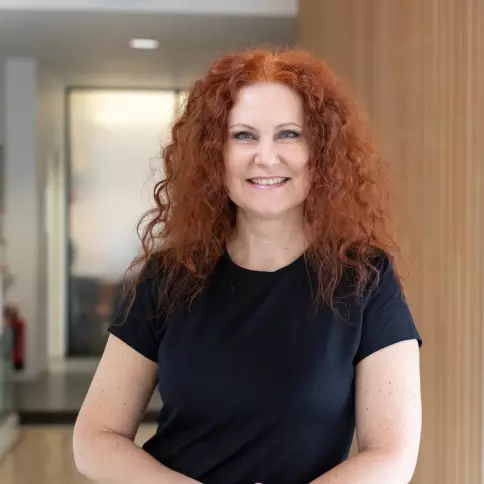
Prof Monika Gullerova, Founder of Raiden Therapeutics
Professor Monika Gullerova is a Professor of Molecular Medicine with a background in RNA biology and therapeutic innovation, and the founder of Raiden Therapeutics, a preclinical-stage biotechnology company harnessing artificial intelligence to discover small molecules that selectively target RNA. By focusing on RNA as a therapeutic target, Raiden aims to unlock new treatments for diseases that have long been considered undruggable.
Based in Oxford at the Sir William Dunn School of Pathology, Raiden Therapeutics currently has a team of five and has secured early-stage seed funding to advance its platform technology and initial therapeutic pipelines.
Alongside building the company, Professor Gullerova was selected for the MIT Royalty Pharma Faculty Founder Initiative and the AstraZeneca Exchange, AstraZeneca's science and business mentoring programme. She also works closely with Oxford University Innovation and EnSpire to translate academic research into real-world impact.
What is your background? What made you decide to become an entrepreneur?

I'm a Professor of Molecular Medicine with a research background in RNA biology, gene expression regulation, genome instability and translational therapeutics. Much of my academic work has focused on understanding how RNA drives disease and how it could be turned into a druggable clinical target. In academia, we are uncovering clear molecular drivers of disease, particularly in the non-coding transcriptome, but have no good tools to drug or inhibit them. That gap between scientific knowledge and clinical impact, pushed me toward entrepreneurship. I founded Raiden Therapeutics to change that. Our ambition is to build the platform that I wished existed in my own lab. At Raiden, we're combining powerful AI platform and my RNA expertise to develop small molecules that target RNA structures directly, with the aim of treating diseases that have been historically undruggable.
Becoming an entrepreneur wasn't a sudden leap, it was a natural extension of my research activity. The difference is that now, I'm building not just papers or projects, but an interdisciplinary team, a trained AI platform and ultimately, a path to novel real-world therapies. What drives me is the belief that the best science shouldn't stay in journals, it should become medicine.
What is your definition of entrepreneurship?
To me, entrepreneurship is the decision to divert from pure fascination of scientific discovery and take a problem we comprehensively understand and build something that doesn't exist yet to solve it. It's not just about starting a company, it's about choosing to move from observation to ownership. As an RNA biologist, I spent years discovering what RNA could do and how. But entrepreneurship is where I stopped waiting for someone else to develop a therapeutic and instead asked: "What if I could?"
It's about courage over certainty, building while learning and surrounding yourself with people who are better than you in all the ways that matter. It's deeply creative, often uncomfortable, and constantly humbling. But it's also one of the most powerful ways to turn an idea, especially one from the bench, into something that can change lives.
How and when did you know your idea was good enough to develop it?
The moment I knew it was more than just a research curiosity was when we built an AI prototype model that combined several modalities for RNA and small molecule features, and it actually started predicting meaningful interactions. It wasn't perfect, but it was enough to show that the concept could work. We then tested a few predictions experimentally and saw functional changes on target genes. That was the turning point.
What would you say are the top 3 skills that needed to be a successful entrepreneur? Why?
Clear Vision. You need to deeply understand the problem you're solving and why it matters to the world. That clarity becomes important when everything else feels uncertain. It helps make decisions, attract the right people, and stay grounded when things get hard (which they will).
Ability to adapt. What works one month may fail the next. The ability to learn fast and keep momentum through change is what keeps an idea alive long enough to become a company. As a scientist, I was trained to question and revise, that mindset is crucial as a founder too.
Resilience (100%). Entrepreneurship is exciting, but also deeply humbling. You will hear no many many times. You will hit dead ends. You will doubt yourself. The ability to stay focused, get back up and keep going is what separates the people who have good ideas from the ones who build lasting impact.
What is your favourite part of being an entrepreneur?
The most rewarding part is seeing ideas move beyond theory into something tangible. In academia, progress is often measured in papers and grants; as an entrepreneur, progress is measured in momentum: building a team, testing a hypothesis in the real world, and watching something grow that has the potential to become medicine. I particularly enjoy the interdisciplinary nature of entrepreneurship: working at the interface of science, technology, strategy and people. It's challenging, but deeply energising.
What individual, company or organization inspires you most? Why?
I'm particularly inspired by scientists and organisations that have embraced the challenge of using AI as a genuine tool to move drug discovery forward, rather than as a superficial add-on. Companies such as Isomorphic Labs and some others, exemplify this approach by applying advanced computational methods to fundamentally hard biological problems, while maintaining deep respect for experimental biology.
What resonates with me most is their willingness to tackle complexity head-on-working at the intersection of biology, chemistry, and computation to address questions that traditional approaches struggle to solve. These companies demonstrate that it's possible to translate rigorous academic thinking into scalable, real-world impact without compromising on scientific depth.
More broadly, I'm inspired by teams that choose difficult, high-risk problems over incremental advances. They set a standard for how ambitious science can be paired with commercial execution, showing that bold ideas, when supported by strong fundamentals, can reshape entire fields.
If you had 5 minutes with the above individual/ company/organization, what would you want to ask or discuss?
What is your next target :-)
What has been your most satisfying or successful moment in business?
One of the most satisfying moments was seeing our early AI predictions translate into real experimental effects in the lab. That was the moment when Raiden shifted from being an idea to a project with genuine commercial potential. It validated years of thinking about RNA biology and convinced me that we were building something fundamentally novel and strong.
What would you say have been some of your mistakes, failures or lessons learned as an entrepreneur?
One lesson I learned early is that not everything needs to be perfect before you move forward. As an academic, I was trained to aim for completeness and precision, but entrepreneurship rewards speed and learning. I've also learned the importance of saying no, protecting focus is essential when resources are limited.
How have you funded your ideas?
Raiden has been funded through a combination of translational grants, seed funding and institutional support. Early support from my department: Sir William Dunn School at University of Oxford was absolutely critical. Further support from university-linked funds and innovation programmes was essential in helping us de-risk the science and build the initial platform before raising external capital.
Are there any sector-specific awards/grants/competitions that have helped you?
Yes, several translational and innovation-focused funding sources have been instrumental. I have secured translational support from Sir William Dunn School of Pathology (Guy Newton grant), University Challenge Seed Fund from OUI, Medical and Life Sciences Translational Fund and Strategic Innovation Fund. These programmes provided not just funding, but also validation, mentorship, and access to networks that were crucial at an early stage.
What is good about being an entrepreneur in Oxfordshire? Bad?
Oxford is an exceptional place to build a science-driven company. The proximity to world-class research, talent, and investors is a huge advantage. The challenge can be that the ecosystem is highly competitive and transitioning from academic culture to startup pace sometimes requires a mindset shift. But overall, the positives far outweigh the negatives.
If a new entrepreneur or startup came to you looking for entrepreneurship resources, where would you send them?
I would point them first to Oxford university innovation hubs and translational funding programmes, as well as to Enspire, Nucleate and OSE. Talking to other founders who are just a few steps ahead is often more valuable than formal advice. I'd also encourage them to seek mentors who understand both science and company building.
Have you faced any challenges as a woman entrepreneur? If so, how have you overcome them?
Like many women in science and entrepreneurship, I've occasionally encountered assumptions about leadership, ambition, or risk tolerance. I've learned to overcome this by being very clear about my expertise and vision, and by surrounding myself with people who value competence over stereotypes. Building confidence through preparation and results has been key. Meeting Prof Dame Molly Stevens was incredible and eye opening, she truly represents an incredible role model and is a proof that women can be hugely successful.
What resources would you recommend for women?
Strong peer networks are incredibly important, communities where women can share experiences openly and support each other. I also think targeted leadership and founder programmes for women make a real difference, particularly those that combine skills training with visibility and sponsorship, such as the MIT-Royalty Pharma Faculty Founder Initiative.
How do you think institutions such as the University of Oxford could better support women entrepreneurs?
Oxford can help by increasing visibility of female founders, normalising non-linear career paths, and providing earlier access to translational funding and commercial training. Creating more role models and actively supporting women through their expansion from academia to entrepreneurship would have a meaningful impact.
Do you have any advice for women who want to be entrepreneurs?
Don't wait until you feel "ready". That moment rarely comes. If you have deep expertise in a problem and the motivation to solve it, you already have a strong foundation. Seek out similarly minded women who has done it, ask for help early and remember that uncertainty is part of the process for everyone, not a sign that you cant make it.
Any last words of advice?
Entrepreneurship is not about having all the answers, it's about being willing to learn in public, take responsibility for your ideas and persist through uncertainty. If you care deeply about a problem and are willing to commit to solving it, that commitment itself becomes your greatest asset.
You can keep up to date with Monika and Raiden Therapeutics by following her on LinkedIn and get in touch with them by emailing her at monika.gullerova@path.ox.ac.uk