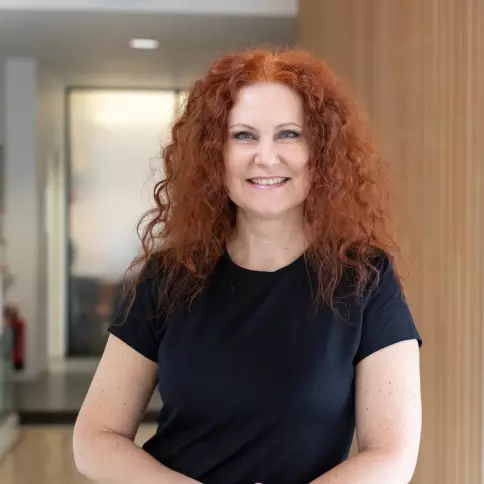
Sally Collins, Founder & Chief Medical Officer of Oxailis
Sally Collins is Co-Founder and Chief Medical Officer of Oxailis, a University of Oxford spin-out translating years of clinical research into scalable healthcare technology. Alongside her academic role as Professor of Obstetrics at Oxford, she founded Oxailis to ensure that robust scientific research moves beyond the laboratory and into real-world clinical care.
Oxailis is commercialising AI-based software that measures tissue perfusion using standard ultrasound, enabling earlier and more accurate risk assessment in pregnancy while opening new possibilities across cancer and chronic disease. As a founder, Sally focuses on preserving scientific integrity while building technology that clinicians trust and healthcare systems can adopt at scale.

What is your background? What made you decide to become an entrepreneur?
My background is as a clinician-scientist. I'm a Professor of Obstetrics at the University of Oxford and a Consultant Obstetrician specialising in fetal medicine. For much of my career, I've focused on placental function and conditions such as fetal growth restriction, working at the intersection of clinical care, imaging, and data science to improve how risk is identified and managed in pregnancy.
I didn't set out to become an entrepreneur. Like many academics, I assumed my role ended with generating evidence and influencing clinical practice through research and guidelines. But over time, it became clear that discovery alone wasn't enough. We had developed a robust, non-invasive way to quantify tissue perfusion using standard ultrasound, and the clinical validation was strong, yet without a commercial pathway, the technology would never reach patients at scale.
Becoming an entrepreneur was therefore a practical and ethical decision. If you have something that can meaningfully improve care and reduce harm, there is a responsibility to ensure it is translated into real-world use. Founding Oxailis was the most effective way to do that.
The transition required a shift in mindset. Academia prioritises certainty and consensus; entrepreneurship demands conviction and progress in the face of uncertainty. I had to learn to move forward before everything was perfectly resolved, while maintaining scientific integrity. It also meant engaging deeply with regulation, product development, and implementation, all essential for impact.
Today, as Co-Founder and Chief Medical Officer, I see entrepreneurship as an extension of my clinical role. The aim is unchanged, notably better outcomes for patients, but the reach is far greater. Through Oxailis, years of academic research can now translate into meaningful, scalable change in maternity and healthcare systems globally.
What is your definition of entrepreneurship?
Entrepreneurship, to me, is the discipline of turning conviction into impact.
It's recognising when knowledge has outgrown the lab or the journal, and having the courage to carry it into the real world, before there is certainty, consensus, or an established path. It's not about building a company for its own sake, but about taking responsibility for translation: ensuring that good science becomes usable, scalable, and meaningful for the people it was intended to serve.
How and when did you know your idea was good enough to develop it?
I knew the idea was good enough to develop once it had proven itself in the real world, at scale. Early on, it was an interesting scientific concept, but in medicine that's never enough. What changed everything was completing two large clinical trials involving more than 7,500 pregnancies. Across those studies, the results were consistent, reproducible, and clinically meaningful not just statistically significant.
Those trials showed that we could reliably quantify placental perfusion using standard ultrasound, and that those measurements added real value to first-trimester risk assessment. Importantly, the technology performed in routine clinical settings, not just specialist centres, which is where many innovations falter.
At the same time, the practical barriers were low. The software worked on existing ultrasound machines, requires no contrast agents, and fits naturally into established clinical workflows. That combination of strong evidence, clinical relevance, and scalability is rare.
The final confirmation came from clinician response. When experienced colleagues moved from scepticism to engagement, asking how they could integrate it into practice rather than whether it worked, I knew the idea had crossed a threshold. At that point, the question was no longer whether it was good enough to develop, but whether we could justify not doing so.
What would you say are the top 3 skills that needed to be a successful entrepreneur? Why?
The first is conviction. Entrepreneurship inevitably involves moving forward before there is full certainty, whether that's scientific, commercial, or cultural. You need the ability to hold a clear vision and commit to it, even when others are sceptical or the path isn't obvious. Without conviction, it's very hard to sustain momentum through the inevitable setbacks.
The second is judgement. Successful entrepreneurship isn't about knowing everything; it's about knowing what matters most at any given moment. That means making decisions with incomplete information, prioritising ruthlessly, and being willing to change course when the evidence tells you to. For me, this skill was shaped by my experience as an obstetrician, where decisions often carry real consequences and must be made carefully but quickly and decisively.
The third is the ability to translate. Ideas only create impact if they can be understood, trusted, and adopted by others. As a founder, you constantly translate between science and product, clinicians and engineers, regulators and investors. Being able to communicate complex ideas clearly, without oversimplifying or losing integrity, is essential for building alignment and trust.
Together, these skills allow you to move forward with purpose: conviction to begin, judgement to navigate, and translation to scale. Without all three, even the strongest ideas struggle to make it into the real world.
What is your favourite part of being an entrepreneur?
My favourite part of being an entrepreneur is seeing ideas turn into real-world impact. In academia, progress can sometimes be slow and abstract; as a founder, you watch years of thinking and developing evidence translate into something tangible that clinicians can use and patients can benefit from.
I also value the sense of shared momentum. Building a company brings together people with very different skills, clinical, technical, commercial, all working towards the same goal. That collective problem-solving, where progress depends on trust and collaboration rather than hierarchy, is deeply energising.
Finally, I appreciate the honesty of entrepreneurship. The feedback is immediate and unfiltered. What works, works; what doesn't, doesn't. That clarity is challenging, but it's also refreshing. It sharpens thinking, accelerates learning, and keeps the focus firmly on impact which, ultimately, is why I am on this path.
What individual, company or organization inspires you most? Why?
I'm particularly inspired by Tania Boler, the founder of Elvie. What resonates with me is not just what she built, but how she built it. She took issues that had long been overlooked or dismissed in healthcare and treated them with seriousness, rigour, and ambition, proving that women's health is neither niche nor optional.
I admire her conviction in backing ideas that challenged both cultural norms and industry assumptions, and her ability to translate a deep understanding of women's needs into products that are clinically credible, commercially successful, and genuinely empowering. She didn't wait for permission or consensus; she led the way.
As a female founder in medtech, I find that deeply motivating. Her journey reinforces my belief that when women trust their expertise and vision, they can redefine entire categories and, in doing so, change both healthcare and expectations of what leadership looks like.
If you had 5 minutes with the above individual/ company/organization, what would you want to ask or discuss?
If I had five minutes with Tania, I'd want to talk about conviction, specifically, how she sustained belief in her vision through the phases when it was still misunderstood or underestimated. I'd be interested in how she navigated moments when the market, investors, or even users weren't yet ready, and what helped her decide when to persist versus when to adapt.
I'd also want to discuss scaling without dilution; how she preserved the integrity of Elvie's mission while growing rapidly and operating in highly regulated healthcare environments. That balance between impact, credibility, and commercial success is something I think about constantly.
Finally, I'd ask what she's learned about leadership as the company evolved, and how her role changed as Elvie moved from bold idea to global brand. Those transitions are often the hardest and the most instructive.
What has been your most satisfying or successful moment in business?
One of the most satisfying moments was seeing the results of two large clinical trials involving more than 7,500 pregnancies and realising what that evidence made possible. Years of work had reached a point where the science was strong enough to change practice and that created a responsibility to act.
But what made that moment truly special was what followed. Finding a co-founder in Basak Yakis-Douglas, who shared both the vision and the courage to take it forward, and then bringing Rory Cameron on as CEO, turned an idea into a real company. Then Oxailis stopped being just a great idea and became a team with momentum.
Seeing strong evidence evolve into collective belief, and into something that can genuinely improve maternity care, has been the most rewarding part of the journey.
What would you say have been some of your mistakes, failures or lessons learned as an entrepreneur?
One of my biggest lessons has been learning to move more quickly in removing obstacles. Early on, I sometimes allowed other people's doubts or institutional caution to slow progress, even when my own conviction was strong. Much of that came from being used to consensus-driven environments, where permission matters.
Entrepreneurship has taught me that not all barriers are real, some exist simply because no one has challenged them yet. I've learned to trust my judgement sooner, act more decisively, and recognise when caution is helpful versus when it's holding things back. That shift has been uncomfortable at times, but essential for progress.
How have you funded your ideas?
The idea behind Oxailis has been funded over many years through rigorous, peer-reviewed research support. The underlying science represents more than 17 years of work at the University of Oxford, supported by leading funders including the NIH, NIHR, and the Sir Jules Thorn Charitable Trust, alongside significant investment from the University of Oxford itself.
That foundation allowed us to build and clinically validate the technology before forming the company. Since spinning out, we've taken a disciplined approach and are bootstrapping the business initially, focusing on regulatory progress, product readiness, and strategic partnerships. For us, this staged funding approach reflects our values: building on strong evidence first, then scaling thoughtfully and sustainably.
Are there any sector-specific awards/grants/competitions that have helped you?
We've been very fortunate to receive support from the University of Oxford's Strategic Innovation Fund, which played a crucial role at a pivotal moment in our journey. That backing signalled confidence not just in the science, but in the ambition to translate it into real-world impact. We're deeply grateful for Oxford's continued belief in the team and the mission, that early, strategic support gave us both momentum and confidence as we moved from research into company-building.
What is good about being an entrepreneur in Oxfordshire? Bad?
Oxfordshire is an exceptional place to be an entrepreneur, particularly in science and healthcare. The density of world-class research, clinical expertise, and talent is hard to match. Being embedded in the Oxford ecosystem means access to deep technical knowledge, translational support, and a culture that takes evidence seriously. There's also a strong sense of community where people are generous with their time and genuinely invested in seeing good ideas succeed.
These same strengths can also create friction. Processes can feel slow, and the culture can be risk-averse, particularly for founders trying to move at startup speed. Decisions relating to our company often involved multiple stakeholders, which can test both momentum and resilience.
That said, if you're building something rooted in deep science and real-world impact, the advantages far outweigh the challenges especially if you're prepared to push pace while navigating the system thoughtfully.
If a new entrepreneur or startup came to you looking for entrepreneurship resources, where would you send them?
Beyond programmes, I'd encourage founders to seek out small, trusted peer groups locally, other founders slightly ahead of you on the journey.
Have you faced any challenges as a woman entrepreneur? If so, how have you overcome them?
Yes, and I think many women recognise this experience. Early on, some of the challenges weren't technical or strategic, but cultural. I encountered situations where my expertise was questioned, my pace was labelled as "difficult," or my conviction was mistaken for risk. Those moments can quietly erode confidence if you let them.
Over time, I learned to lean in rather than soften. I stopped over-explaining, stopped waiting for validation, and became much more comfortable setting boundaries and being direct. I also learned not to absorb behaviour that had nothing to do with the quality of my work.
What helped most was trusting my evidence, my experience, and my instincts and surrounding myself with people who respected them. Entrepreneurship has reinforced that leadership doesn't require permission, and that clarity and conviction are often the most effective responses.
What resources would you recommend for women?
I'd recommend resources that combine rigour, community, and real-world perspective. Programmes like the Oxford/MIT Royalty Pharma Faculty Founder Initiative are proving invaluable to me as they're designed specifically for academic founders and help bridge the gap between deep science and commercial execution, without oversimplifying either.
Alongside formal programmes, I'd encourage women to invest time in peer networks, particularly other female founders such as Inspiring Female Founders, a major initiative led by Professor Pinar Ozcan for the Oxford Saïd Entrepreneurship Centre, and to seek mentors who challenge as well as support them. Ultimately, the most important resource is learning to trust your own judgement and backing it with evidence. That combination is transformative.
How do you think institutions such as the University of Oxford could better support women entrepreneurs?
Institutions like the University of Oxford already do a great deal to support innovation, but there's an opportunity to be more intentional about how women are supported through the entrepreneurial journey. One of the most important shifts is recognising that women often face different structural and cultural barriers, particularly around confidence, visibility, and access to informal networks where key decisions are made.
Practical support matters, clearer pathways to commercialisation, earlier exposure to entrepreneurial role models, and programmes designed specifically for female academic founders make a real difference. Equally important is cultural support: normalising ambition, backing conviction early, and reducing the need for women to repeatedly justify pace or leadership style.
Finally, institutions can help by actively removing friction, simplifying processes, challenging unnecessary gatekeeping, and ensuring women have access to senior sponsors. When support is proactive rather than reactive, women are far more likely to step forward and lead.
Do you have any advice for women who want to be entrepreneurs?
My advice is to trust your conviction, especially early on. Women are often encouraged to wait for certainty or permission before stepping forward, but entrepreneurship rarely offers either. If you see a real problem and believe you can help solve it, that belief is enough to begin.
Don't underestimate the value of your perspective. Many of the most important opportunities exist precisely because certain voices and experiences have been missing. What may feel niche or personal is often a signal of unmet need.
At the same time, be rigorous. Conviction should be paired with evidence, curiosity, and a willingness to learn quickly. Surround yourself with people who challenge you constructively and complement your skills: you don't need to do everything yourself.
Finally, remember that leadership doesn't have to look a certain way. You don't need to mimic existing models to be effective. Build in a way that reflects your values, your strengths, and your definition of success. Progress often comes from leading the way before others can see where you're going.
Any last words of advice?
Back yourself sooner than you think you should. If you can see the problem clearly and you care enough to solve it, that already puts you ahead. You don't need permission, perfect timing, or universal agreement to begin.
Be intentional about the people you bring with you, build with those who share your values and have the courage to challenge you when it matters. Protect your energy and your vision; both are precious.
And when it gets uncomfortable, because it definitely will, remember that this often means you're doing something new and important. Keep going. Leading the way is rarely easy, but it's how real change happens.
You can keep up to date with Sally and Oxailis by following her on LinkedIn and get in touch with them by emailing her at sally.collins@oxailis.com